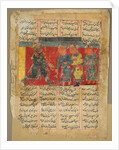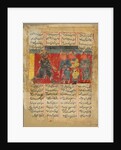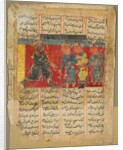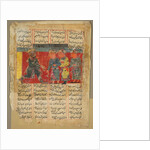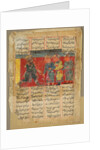
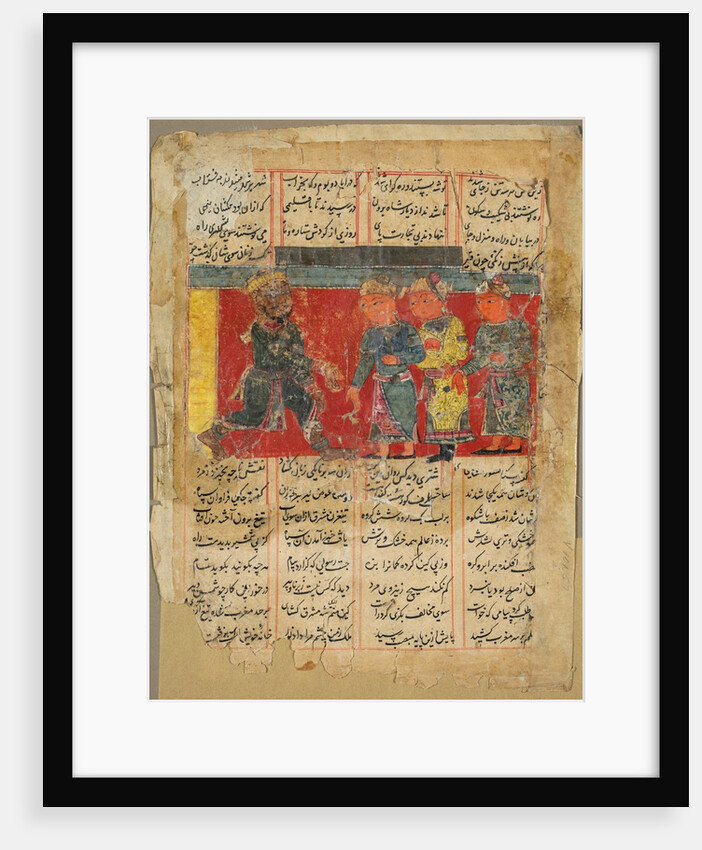
A King Receiving Three Men, page from the Khamsa of Amir Khusrau Dihlavi, 1450-1500
Image information
Sizing information
| Overall size (inc frame) | x cm ( x in) |
| Depth | cm (in) |
| Artwork | x cm ( x in) |
| Border (mount) |
cm
top/bottom
(in)
cm left/right (in) |
| The paper size of our wall art shipped from the US is sized to the nearest inch. | |

Our framed prints
Every framed picture is created by hand in our workshop by specialist framers.
Black, white, silver, gold or natural frames available, supplied ready to hang.
All our frames have a smooth satin finish, and measure 20mm (front face) by 23mm (depth from wall).
Read more about our framed art prints.
Manufactured in the UK, the US and the EU
All products are created to order in our print factories around the globe, and we are the trusted printing partner of many high profile and respected art galleries and museums.
We are proud to have produced over 1 million prints for hundreds of thousands of customers.
Delivery & returns
We print everything to order so delivery times may vary but all framed pictures are despatched within 3 days.
Delivery to the UK, EU & US is free when you spend £75. Otherwise, delivery to the UK costs £10 for a single framed print.
We will happily replace your order if everything isn’t 100% perfect.
Product images of A King Receiving Three Men, page from the Khamsa of Amir Khusrau Dihlavi, 1450-1500




Product details A King Receiving Three Men, page from the Khamsa of Amir Khusrau Dihlavi, 1450-1500
A King Receiving Three Men, page from the Khamsa of Amir Khusrau Dihlavi, 1450-1500
A King Receiving Three Men, page from the Khamsa of Amir Khusrau Dihlavi, 1450-1500. The text on this page discusses the wars between Morocco and Zang, a region of eastern Africa centered in present-day Ethiopia. In the painting the King of Zang meets three envoys. The dramatic gesture of the Zangi king, who stretches out one hand as he takes an enormous stride toward the envoys, identifies him as a powerful, assertive figure. This page is from the first known manuscript of a Persian literary text illustrated by an Indian artist, who had probably been trained in the Jain manuscript tradition. The figures are arranged on one plane in a straight line against a flat red background, typical of manuscript painting in India in the 1400s.
- Image ref: 2722110
- Heritage Art/Heritage Images
Find related images
zoom