
Sizing information
| Overall size (inc frame) | x cm ( x in) |
| Depth | cm (in) |
| Artwork | x cm ( x in) |
| Border (mount) |
cm
top/bottom
(in)
cm left/right (in) |
| The paper size of our wall art shipped from the US is sized to the nearest inch. | |

Our prints
We use a 200gsm fine art paper and premium branded inks to create the perfect reproduction.
Our expertise and use of high-quality materials means that our print colours are independently verified to last between 100 and 200 years.
Read more about our fine art prints.
Manufactured in the UK, the US and the EU
All products are created to order in our print factories around the globe, and we are the trusted printing partner of many high profile and respected art galleries and museums.
We are proud to have produced over 1 million prints for hundreds of thousands of customers.
Delivery & returns
We print everything to order so delivery times may vary but all unframed prints are despatched within 1–3 days.
Delivery to the UK, Ireland, mainland EU & US is free when you spend £75. Otherwise, delivery to the UK costs £5 for an unframed print of any size.
We will happily replace your order if everything isn’t 100% perfect.
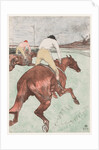
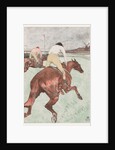
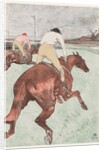
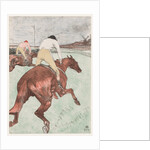
Product images of The Jockey, 1899


Product details The Jockey, 1899
The Jockey, 1899
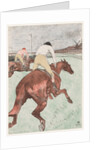
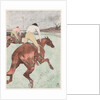
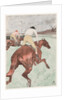
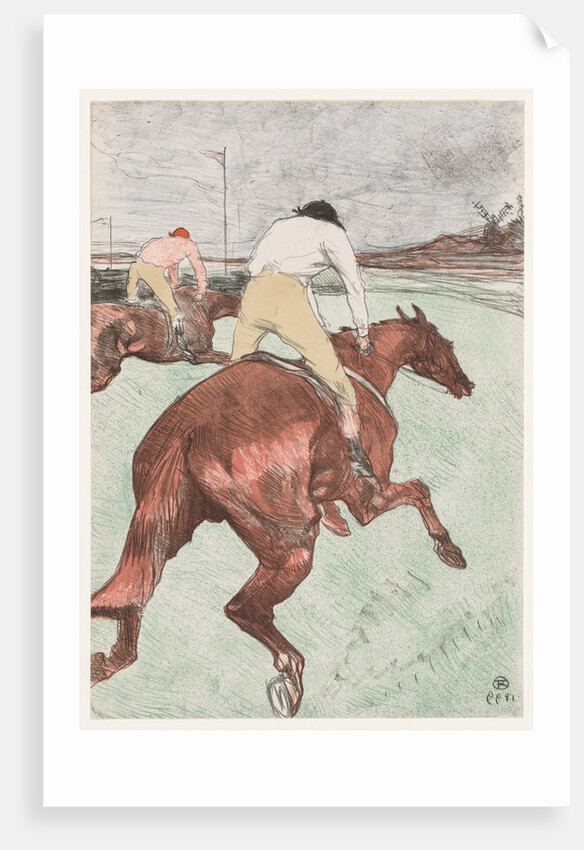
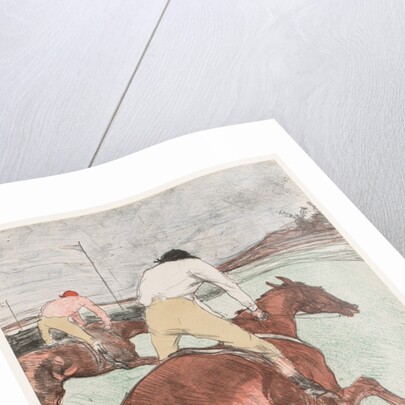
The Jockey, 1899. Motivated by the popularity of the races, Henri de Toulouse-Lautrec executed this lithograph both in colour, seen here, and in black and white. He intended to publish the colour version in a portfolio of horse-racing subjects, but the project never came to fruition and Jockey was published alone. The artist's admiration for Edgar Degas's horse-racing pictures is clear in Jockey , and he shared Degas's appreciation of Japanese ukiyo-e woodblock prints. Particular elements of the lithograph reveal the influence of the Japanese woodcut: the overall flatness; the daring cropping?particularly of the background horse whose head and hindquarters have been omitted; the pale green hue of the grass and the blue-violet sky; and the dramatic, rushing perspective of the horses galloping into the distance. However, the younger artist incorporated the Japanese aesthetic into his own visual language in an entirely original way. Unlike Degas, Toulouse-Lautrec ignored Eadweard Muybridge's photographs and depicted his horse and rider in the physically impossible "flying-gallop" position.
- Image ref: 2744730
- Heritage Art/Heritage Images
Find related images
zoom