
Sizing information
| Overall size (inc frame) | x cm ( x in) |
| Depth | cm (in) |
| Artwork | x cm ( x in) |
| Border (mount) |
cm
top/bottom
(in)
cm left/right (in) |
| The paper size of our wall art shipped from the US is sized to the nearest inch. | |

Our framed prints
Every framed picture is created by hand in our workshop by specialist framers.
Black, white, silver, gold or natural frames available, supplied ready to hang.
All our frames have a smooth satin finish, and measure 20mm (front face) by 23mm (depth from wall).
Read more about our framed art prints.
Manufactured in the UK, the US and the EU
All products are created to order in our print factories around the globe, and we are the trusted printing partner of many high profile and respected art galleries and museums.
We are proud to have produced over 1 million prints for hundreds of thousands of customers.
Delivery & returns
We print everything to order so delivery times may vary but all framed pictures are despatched within 3 days.
Delivery to the UK, Ireland, mainland EU & US is free when you spend £75. Otherwise, delivery to the UK costs £10 for a single framed print.
We will happily replace your order if everything isn’t 100% perfect.
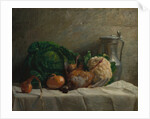
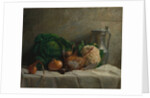
Product images of Still Life with Vegetables, Partridge, and a Jug, 1858



Product details Still Life with Vegetables, Partridge, and a Jug, 1858
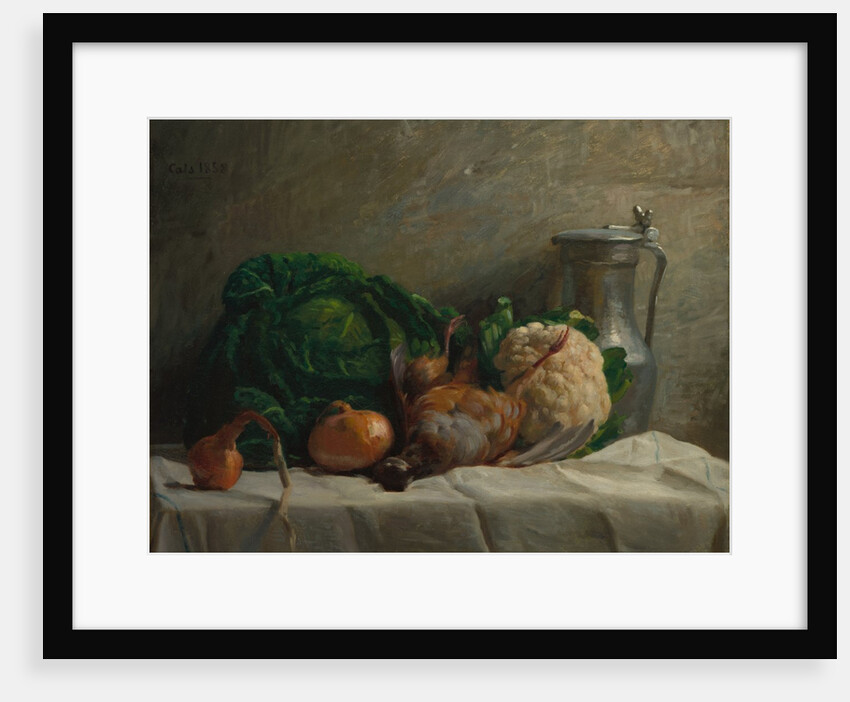
Still Life with Vegetables, Partridge, and a Jug, 1858
Still Life with Vegetables, Partridge, and a Jug, 1858. During the 19th century, a number of painters used common objects (rather than rare or refined objects), to create still lifes that some critics judged as unfit for the drawing room: studies of carrots, cabbages, asparagus, oysters, onions, eggs, and cooking utensils. Often these subjects were chosen for their mealtime associations. The food represented on the table in this painting--a partridge, onions, and cabbage--are the main ingredients for the making of the well-known dish, perdrix au chou (partridge with cabbage). Cals, however, was also interested in exploring underlying compositional design principles and studying the shapes of the objects he depicted. Cals lived and worked in and around Paris for most of his life, though in 1871 he moved to Normandy. In 1874 he participated in the first Impressionist exhibi-tion and continued to do so until 1879. Although still lifes were an important part of his production, they were not his specialty. He preferred to work outdoors, in places chosen during his daily strolls. Art critic Edmond About, who was usually not very generous with compliments, characterized Cals as the most sincere and genuine artist he had ever known.
- Image ref: 2742234
- Heritage Art/Heritage Images
Find related images
zoom