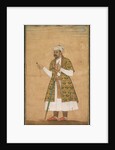
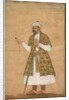
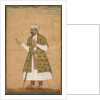
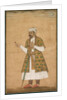

A Courtier, Possibly Khan Alam, Holding a Spinel and a Deccan Sword, c. 1605-1610
Image information
Sizing information
| Overall size (inc frame) | x cm ( x in) |
| Depth | cm (in) |
| Artwork | x cm ( x in) |
| Border (mount) |
cm
top/bottom
(in)
cm left/right (in) |
| The paper size of our wall art shipped from the US is sized to the nearest inch. | |

Our framed prints
Every framed picture is created by hand in our workshop by specialist framers.
Black, white, silver, gold or natural frames available, supplied ready to hang.
All our frames have a smooth satin finish, and measure 20mm (front face) by 23mm (depth from wall).
Read more about our framed art prints.
Manufactured in the UK, the US and the EU
All products are created to order in our print factories around the globe, and we are the trusted printing partner of many high profile and respected art galleries and museums.
We are proud to have produced over 1 million prints for hundreds of thousands of customers.
Delivery & returns
We print everything to order so delivery times may vary but all framed pictures are despatched within 3 days.
Delivery to the UK, Ireland, mainland EU & US is free when you spend £75. Otherwise, delivery to the UK costs £10 for a single framed print.
We will happily replace your order if everything isn’t 100% perfect.
Product images of A Courtier, Possibly Khan Alam, Holding a Spinel and a Deccan Sword, c. 1605-1610




Product details A Courtier, Possibly Khan Alam, Holding a Spinel and a Deccan Sword, c. 1605-1610
A Courtier, Possibly Khan Alam, Holding a Spinel and a Deccan Sword, c. 1605-1610
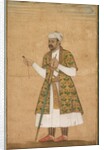
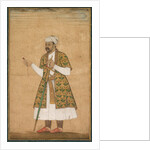
A Courtier, Possibly Khan Alam, Holding a Spinel and a Deccan Sword, c. 1605-1610. According to Akbar's court historian, the emperor ordered likenesses to be taken of the grandees of his realm. "An immense album was thus formed: those that have passed away have received a new life, and those who are still alive have immortality promised them." Akbar's son and successor, Jahangir (reigned 1605-27), continued the tradition of commissioning works of lifelike portraiture for inclusion in imperial albums. This courtier wears an opulent fur-trimmed, fringed velvet coat over his belted white tunic and striped pants-the typical Mughal dress derived from their roots among the nomadic horse-riding people of Central Asia. The artist has reveled in creating the soft textures of the facial hair, fur and fabrics. He holds a ruby-like gemstone called a spinel, which was prized among the Mughals for its talismanic properties of protection during battle.
- Image ref: 2722036
- Heritage Art/Heritage Images
Find related images
zoom