


Sizing information
| Overall size (inc frame) | x cm ( x in) |
| Depth | cm (in) |
| Artwork | x cm ( x in) |
| Border (mount) |
cm
top/bottom
(in)
cm left/right (in) |
| The paper size of our wall art shipped from the US is sized to the nearest inch. | |

Our framed prints
Every framed picture is created by hand in our workshop by specialist framers.
Black, white, silver, gold or natural frames available, supplied ready to hang.
All our frames have a smooth satin finish, and measure 20mm (front face) by 23mm (depth from wall).
Read more about our framed art prints.
Manufactured in the UK, the US and the EU
All products are created to order in our print factories around the globe, and we are the trusted printing partner of many high profile and respected art galleries and museums.
We are proud to have produced over 1 million prints for hundreds of thousands of customers.
Delivery & returns
We print everything to order so delivery times may vary but all framed pictures are despatched within 3 days.
Delivery to the UK, Ireland, mainland EU & US is free when you spend £75. Otherwise, delivery to the UK costs £10 for a single framed print.
We will happily replace your order if everything isn’t 100% perfect.
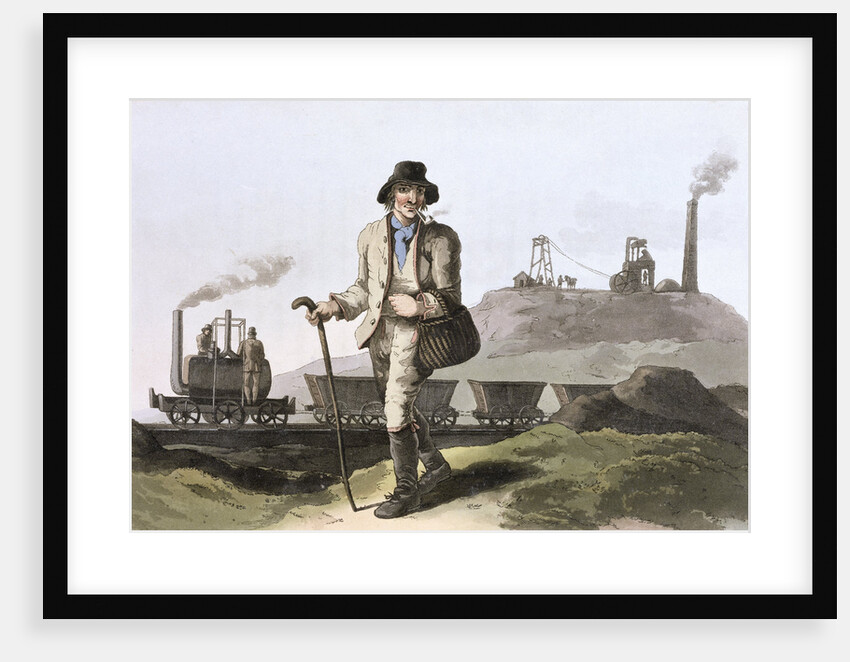
Product images of Blenkinsop steam locomotive at Middleton colliery near Leeds



Product details Blenkinsop steam locomotive at Middleton colliery near Leeds
Blenkinsop steam locomotive at Middleton colliery near Leeds
Blenkinsop steam locomotive at Middleton colliery near Leeds, West Yorkshire, 1814. From Costume of Yorkshire by George Walker, 1814. Mining engineer and inventor John Blenkinsop (1783-1831) designed the first practicable steam locomotive, the 'Salamanca', in 1812. It operated by means of a rack and pinion system. Richard Trevithick had built a steam locomotive in 1805 for Wylam colliery, but it had been too heavy for the cast iron rails it was meant to run on. Middleton colliery laid iron edge rails, which were stronger than those used at Wylam. Blenkinsop went on to build three further locomotives for the colliery, which carried on operating on the railway into the 1830s. In the meantime, further improvements in rail design meant that heavier adhesion locomotives could be used, superseding Blenkinsop's rack and pinion engines.
- Image ref: 1633037
- Stapleton Historical Collection / Heritage Images
Find related images
zoom


