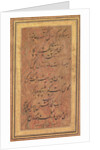
Eight Lines of Musical Poetry of the Jajner Nauras of Ibrahim Adil Shah…, late 1600s
Image information
Sizing information
| Overall size (inc frame) | x cm ( x in) |
| Depth | cm (in) |
| Artwork | x cm ( x in) |
| Border (mount) |
cm
top/bottom
(in)
cm left/right (in) |
| The paper size of our wall art shipped from the US is sized to the nearest inch. | |

Our framed prints
Every framed picture is created by hand in our workshop by specialist framers.
Black, white, silver, gold or natural frames available, supplied ready to hang.
All our frames have a smooth satin finish, and measure 20mm (front face) by 23mm (depth from wall).
Read more about our framed art prints.
Manufactured in the UK, the US and the EU
All products are created to order in our print factories around the globe, and we are the trusted printing partner of many high profile and respected art galleries and museums.
We are proud to have produced over 1 million prints for hundreds of thousands of customers.
Delivery & returns
We print everything to order so delivery times may vary but all framed pictures are despatched within 3 days.
Delivery to the UK, Ireland, mainland EU & US is free when you spend £75. Otherwise, delivery to the UK costs £10 for a single framed print.
We will happily replace your order if everything isn’t 100% perfect.
Product images of Eight Lines of Musical Poetry of the Jajner Nauras of Ibrahim Adil Shah…, late 1600s



Product details Eight Lines of Musical Poetry of the Jajner Nauras of Ibrahim Adil Shah…, late 1600s
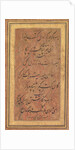
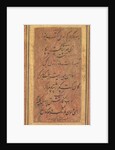
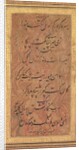
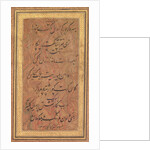
Eight Lines of Musical Poetry of the Jajner Nauras of Ibrahim Adil Shah…, late 1600s
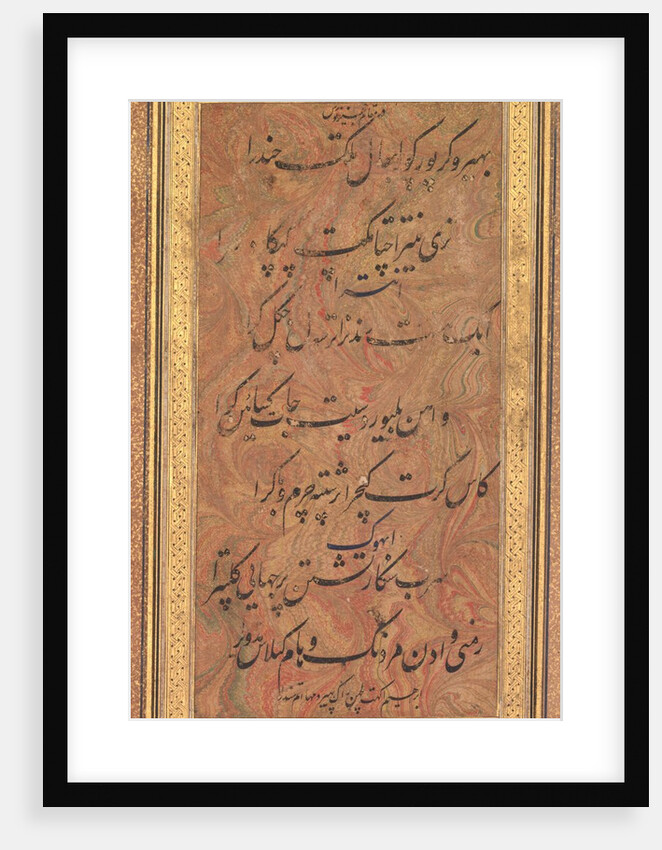
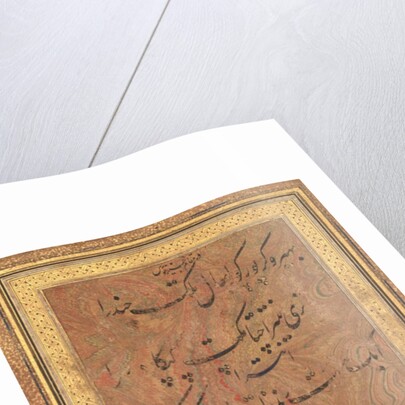
Eight Lines of Musical Poetry of the Jajner Nauras (Rag Bhairav) of Ibrahim Adil Shah of Bijapur, late 1600s. Ibrahim Adil Shah II was a visionary ruler in the southern territories of the Deccan between 1580 and 1627 with his court based in the city of Bijapur. He maintained independence from Mughal encroachments from the north and fostered a distinctive culture infused with mystical Sufi ideals and a distinctive blending of Hindu and Islamic elements. This work of calligraphy is a verse composed by Ibrahim Adil Shah II that exemplifies his love of music and poetry. Normally a Hindu court tradition, ragamalas, or musical modes, were recast by Ibrahim Adil Shah in the local Dakhini language and incorporated into his Islamic milieu. The spectacular marbling on which the verse is written in Arabic script is a characteristic of the Deccan, where marbling was prized for its mysterious and random beauty. Mounted on an imperial Mughal album page with an image of the Hindu ruler Ram Singh on the verso, the placement of this Deccani calligraphy may have functioned as a tribute to Ram Singh?s father, who served the Mughal emperor in the Deccan from 1659 until 1666.
- Image ref: 2727829
- Heritage Art/Heritage Images
Find related images
zoom