Sizing information
| Overall size (inc frame) | x cm ( x in) |
| Depth | cm (in) |
| Artwork | x cm ( x in) |
| Border (mount) |
cm
top/bottom
(in)
cm left/right (in) |
| The paper size of our wall art shipped from the US is sized to the nearest inch. | |

Our prints
We use a 200gsm fine art paper and premium branded inks to create the perfect reproduction.
Our expertise and use of high-quality materials means that our print colours are independently verified to last between 100 and 200 years.
Read more about our fine art prints.
Manufactured in the UK, the US and the EU
All products are created to order in our print factories around the globe, and we are the trusted printing partner of many high profile and respected art galleries and museums.
We are proud to have produced over 1 million prints for hundreds of thousands of customers.
Delivery & returns
We print everything to order so delivery times may vary but all unframed prints are despatched within 1–3 days.
Delivery to the UK, EU & US is free when you spend £75. Otherwise, delivery to the UK costs £5 for an unframed print of any size.
We will happily replace your order if everything isn’t 100% perfect.
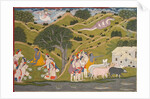
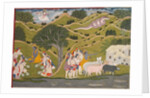
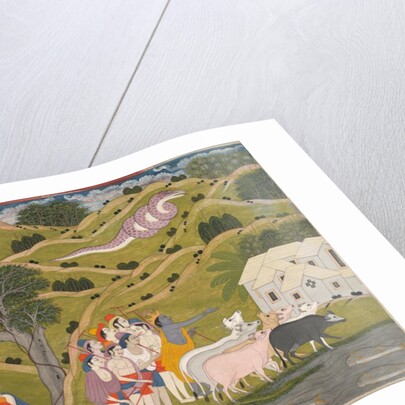
Product images of Krishna Returns with the Cowherds to Braj, from a Bhagavata Purana, c. 1830


Product details Krishna Returns with the Cowherds to Braj, from a Bhagavata Purana, c. 1830
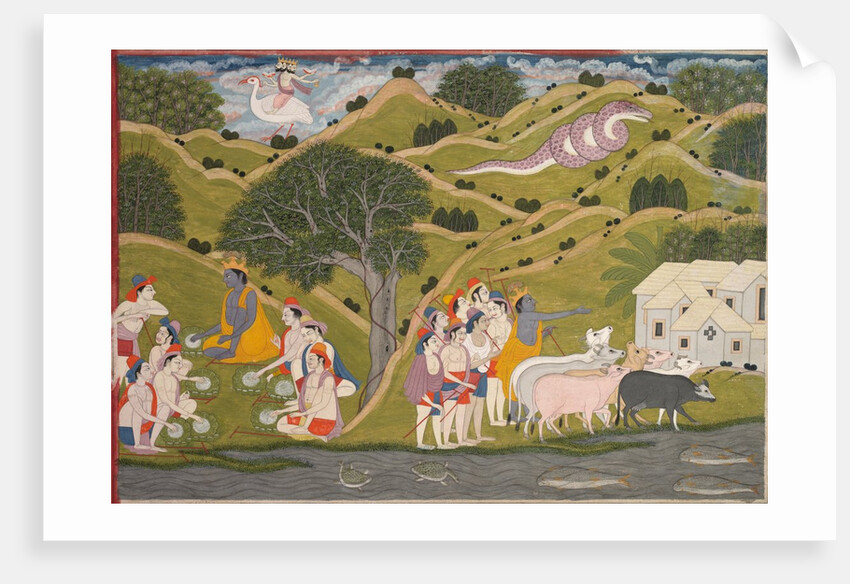
Krishna Returns with the Cowherds to Braj, from a Bhagavata Purana, c. 1830
Krishna Returns with the Cowherds to Braj, from a Bhagavata Purana, c. 1830. This miniature summarizes some of Krishna's many exploits with the cowherds. The later Pahari artists from the courts and small kingdoms in the western Himalayan foothills often use this device of combining many sequential events within one composition. In the background, the figure of the Hindu god Brahma, riding on his goose and holding the attributes of a Hindu priest (sacred texts, prayer beads, and water pot), references the various competitions in which he tried to engage Krishna at the cowherds expense. In the upper right is Aghasura, the giant snake demon who opened his mouth so that the cowherds entered, thinking it a cave; Krishna also went in and, swelling instead, burst the demon, so they could all escape through the top of his head. The two scenes in the foreground, also traditional subjects, are contrastingly peaceful, quotidian and bucolic, rather than heroic. Although the attribution to Hindur?a small state aligned with Kangra?is possible, the series more closely resembles works done in Garhwal, visually. Heavy striations across layers of rippling hills capped with small, round bushes are a typical feature of Garhwal landscapes, and flowering trees along with bare branches protruding from trees or bushes also characterize the Garhwal style. Finally, figures drawn with heavy outlines are seen in many paintings from Garhwal, as they are in this series.
- Image ref: 2748633
- Heritage Art/Heritage Images
Find related images
zoom