Sizing information
| Overall size (inc frame) | x cm ( x in) |
| Depth | cm (in) |
| Artwork | x cm ( x in) |
| Border (mount) |
cm
top/bottom
(in)
cm left/right (in) |
| The paper size of our wall art shipped from the US is sized to the nearest inch. | |

Our prints
We use a 200gsm fine art paper and premium branded inks to create the perfect reproduction.
Our expertise and use of high-quality materials means that our print colours are independently verified to last between 100 and 200 years.
Read more about our fine art prints.
Manufactured in the UK, the US and the EU
All products are created to order in our print factories around the globe, and we are the trusted printing partner of many high profile and respected art galleries and museums.
We are proud to have produced over 1 million prints for hundreds of thousands of customers.
Delivery & returns
We print everything to order so delivery times may vary but all unframed prints are despatched within 1–3 days.
Delivery to the UK, Ireland, mainland EU & US is free when you spend £75. Otherwise, delivery to the UK costs £5 for an unframed print of any size.
We will happily replace your order if everything isn’t 100% perfect.
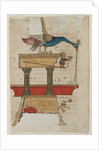
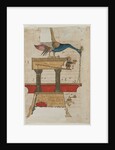
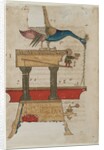
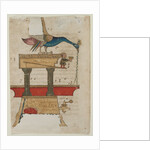
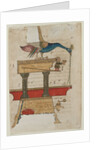
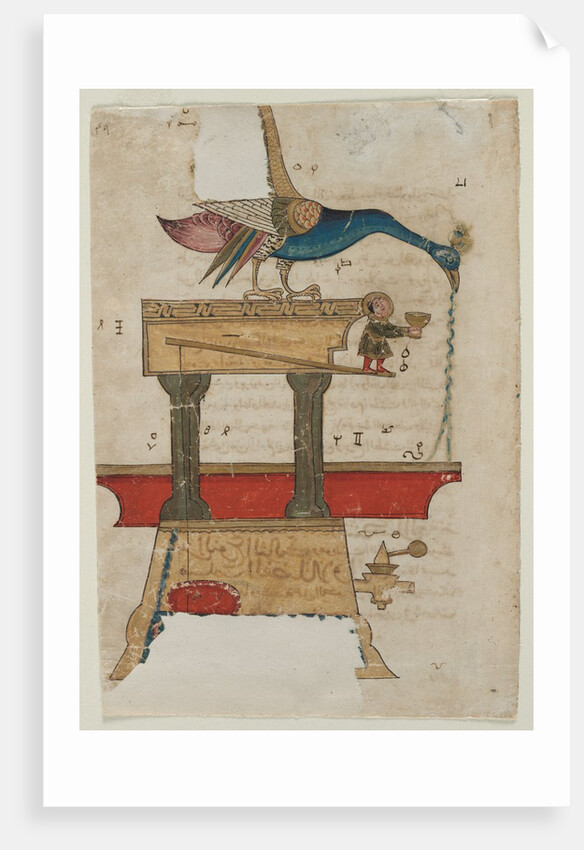
Product images of Peacock-shaped Hand Washing Device; Text Page, Arabic Prose, 1315



Product details Peacock-shaped Hand Washing Device; Text Page, Arabic Prose, 1315
Peacock-shaped Hand Washing Device; Text Page, Arabic Prose, 1315
Peacock-shaped Hand Washing Device (recto); Text Page, Arabic Prose (verso), 1315. This leaf from a 1315 Syrian copy of Ibn al-Razzaz al-Jazari?s The Book of Knowledge of Ingenious Mechanical Devices , written in 1206, depicts a peacock basin automaton for ritual hand washing. There are 15 surviving manuscript copies of al-Jazari?s work, ranging from the early 13th to the late 19th century. An engineer from upper Mesopotamia, al-Jazari was in the service of King Nasri al-Din when he completed his masterwork, an anthology of automated devices including clocks, trick vessels for drinking sessions, devices for washing, fountains, water-raising machines, and measuring instruments. His designs clearly illustrate that automata were not innovations from Western Europe, but they stemmed from a tradition known in the ancient, Islamic, and Byzantine worlds. We do not know with certainty that al-Jazari?s device was ever actually constructed.
- Image ref: 2737507
- Heritage Art/Heritage Images
Find related images
zoom