


Sizing information
| Overall size (inc frame) | x cm ( x in) |
| Depth | cm (in) |
| Artwork | x cm ( x in) |
| Border (mount) |
cm
top/bottom
(in)
cm left/right (in) |
| The paper size of our wall art shipped from the US is sized to the nearest inch. | |

Our framed prints
Every framed picture is created by hand in our workshop by specialist framers.
Black, white, silver, gold or natural frames available, supplied ready to hang.
All our frames have a smooth satin finish, and measure 20mm (front face) by 23mm (depth from wall).
Read more about our framed art prints.
Manufactured in the UK, the US and the EU
All products are created to order in our print factories around the globe, and we are the trusted printing partner of many high profile and respected art galleries and museums.
We are proud to have produced over 1 million prints for hundreds of thousands of customers.
Delivery & returns
We print everything to order so delivery times may vary but all framed pictures are despatched within 3 days.
Delivery to the UK, Ireland, mainland EU & US is free when you spend £75. Otherwise, delivery to the UK costs £10 for a single framed print.
We will happily replace your order if everything isn’t 100% perfect.
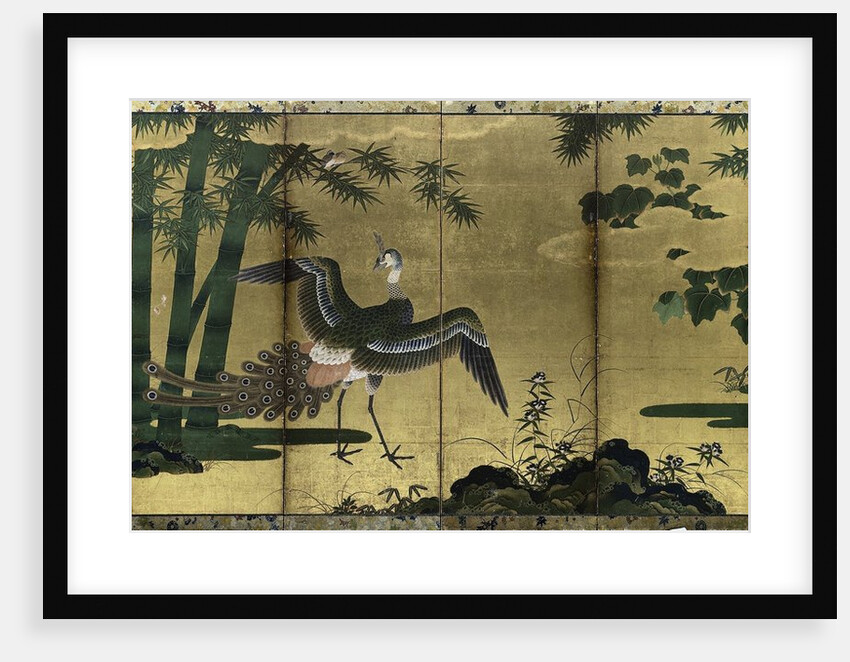
Product images of Peacocks and Bamboo, late 1500s




Product details Peacocks and Bamboo, late 1500s
Peacocks and Bamboo, late 1500s
Tosa Mitsuyoshi (attributed to)
Peacocks and Bamboo, late 1500s. The immense heraldic birds on display in these byøbu reflect the Momoyama era's spirit of newly gained self-confidence and an affinity for grand expressive statements in painting, architecture, the textile and ceramic arts, as well as garden design. The setting is composed of highly stylized lozenges of mineral green paint, suggesting the earth from which clumps of grass, flowering plants, and towering bamboo and paulownia trees emerge. Clusters of lumpy, blue-green rocks dotted with lichen provide stabilizing three-dimensional foils for these islands of vegetation as well as the all-encompassing flat, golden surface. The glorious artificiality of the setting precisely serves the artist's effort to compose a credible yet other-worldly vista for depicting the legendary phoenix gazing across the landscape at the pair of peacocks. Rather than an emblem of immortality, as it is in Western lore, in Japan the phoenix evolved out of its origins in Chinese mythology to become, by the sixteenth century, an auspicious symbol of political authority. Together with clusters of the distinctively shaped paulownia leaves, this long-tailed, mythical bird graced lacquerware as well as mural paintings, proclaiming an air of graceful com-mand. A characteristic infusion of temporality has been included also, through a seasonal flowering schema extending from spring to early summer (right) to fall and the advent of winter (left). Although traditionally attributed to the Tosa school master Tosa Mitsuyoshi (1539-1613), these byøbu possess neither seals nor signatures to confirm that authorship. Known for his jewel-like, modest-sized album paintings of courtly narratives such as The Tale of Genji, it is likely both studio training and contemporary fashions in patronage conspired to produce a good number of such byøbu. This example from the Momoyama era represents one such effort from a masterful Tosa painter, too little seen in Western collections.
- Image ref: 2748672
- Heritage Art/Heritage Images
Find related images
zoom


