


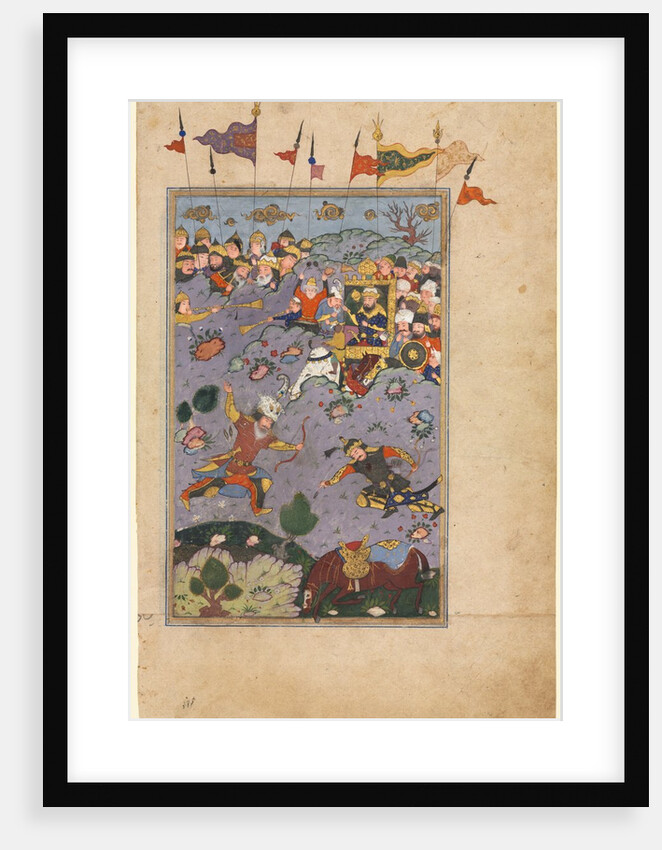
Rustam meets the challenge of Ashkabus, from a Shah-nama of Firdausi…c1590-1600
Image information
Sizing information
| Overall size (inc frame) | x cm ( x in) |
| Depth | cm (in) |
| Artwork | x cm ( x in) |
| Border (mount) |
cm
top/bottom
(in)
cm left/right (in) |
| The paper size of our wall art shipped from the US is sized to the nearest inch. | |

Our framed prints
Every framed picture is created by hand in our workshop by specialist framers.
Black, white, silver, gold or natural frames available, supplied ready to hang.
All our frames have a smooth satin finish, and measure 20mm (front face) by 23mm (depth from wall).
Read more about our framed art prints.
Manufactured in the UK, the US and the EU
All products are created to order in our print factories around the globe, and we are the trusted printing partner of many high profile and respected art galleries and museums.
We are proud to have produced over 1 million prints for hundreds of thousands of customers.
Delivery & returns
We print everything to order so delivery times may vary but all framed pictures are despatched within 3 days.
Delivery to the UK, Ireland, mainland EU & US is free when you spend £75. Otherwise, delivery to the UK costs £10 for a single framed print.
We will happily replace your order if everything isn’t 100% perfect.
Product images of Rustam meets the challenge of Ashkabus, from a Shah-nama of Firdausi…c1590-1600



Product details Rustam meets the challenge of Ashkabus, from a Shah-nama of Firdausi…c1590-1600
Rustam meets the challenge of Ashkabus, from a Shah-nama of Firdausi…c1590-1600
Rustam meets the challenge of Ashkabus, from a Shah-nama (Book of Kings) of Firdausi (Persian, about 934-1020), c. 1590-1600. Iran was losing a battle against Turan and the armies of its assembled allies from India and China. The hero Rustam arrived to pull the Iranian army back from the brink of destruction, slaying the enemy warrior Ashkabus on foot while allowing his horse Rakhsh to rest after a long, hard journey. The vast number of armies involved in the battle is indicated by the many banners that extend beyond the illustration?s top border. This painting was probably produced at Shiraz, one of Iran?s major cultural centers, far to the south of the Safavid capital of Tabriz. Artists and works of art moved back and forth steadily between Shiraz and the Deccan in southwestern India during the 1500s and 1600s.
- Image ref: 2739503
- Heritage Art/Heritage Images
Find related images
zoom


