Sizing information
| Overall size (inc frame) | x cm ( x in) |
| Depth | cm (in) |
| Artwork | x cm ( x in) |
| Border (mount) |
cm
top/bottom
(in)
cm left/right (in) |
| The paper size of our wall art shipped from the US is sized to the nearest inch. | |

Our framed prints
Every framed picture is created by hand in our workshop by specialist framers.
Black, white, silver, gold or natural frames available, supplied ready to hang.
All our frames have a smooth satin finish, and measure 20mm (front face) by 23mm (depth from wall).
Read more about our framed art prints.
Manufactured in the UK, the US and the EU
All products are created to order in our print factories around the globe, and we are the trusted printing partner of many high profile and respected art galleries and museums.
We are proud to have produced over 1 million prints for hundreds of thousands of customers.
Delivery & returns
We print everything to order so delivery times may vary but all framed pictures are despatched within 3 days.
Delivery to the UK, Ireland, mainland EU & US is free when you spend £75. Otherwise, delivery to the UK costs £10 for a single framed print.
We will happily replace your order if everything isn’t 100% perfect.
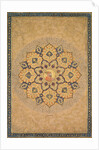
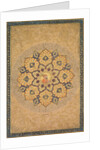
Product images of Shamsa with portrait of Aurangzeb, from the Emperor's Album?




Product details Shamsa with portrait of Aurangzeb, from the Emperor's Album?
Shamsa with portrait of Aurangzeb, from the Emperor's Album?
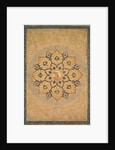
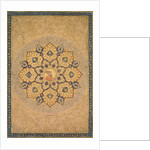
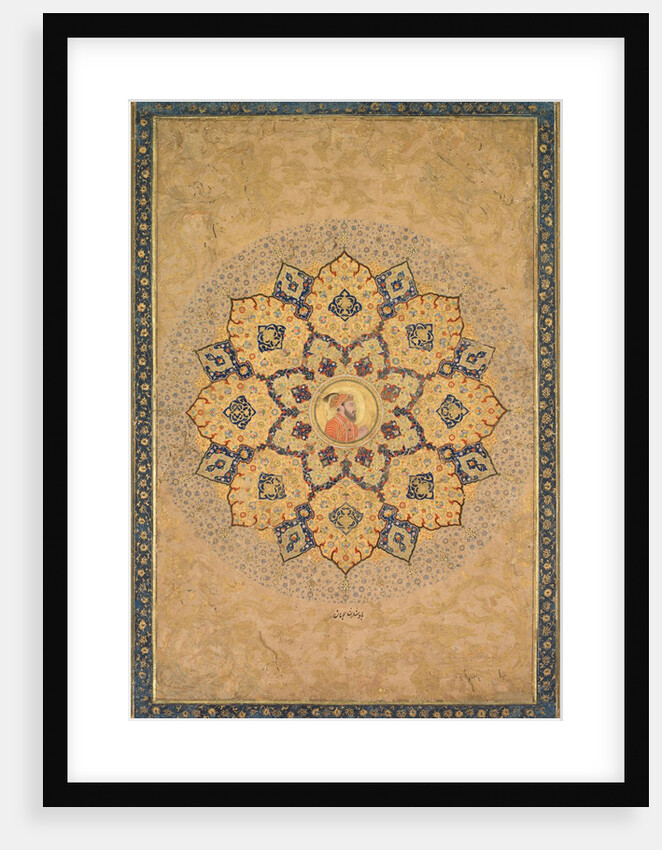
Shamsa (sunburst) with portrait of Aurangzeb (1618-1707), from the Emperor's Album (the Kevorkian Album), illumination 1640-55; original portrait c. 1640-50; altered after 1658. This closing page of an imperial Mughal album originally had the shamsa, or sunburst, with a plain gold disc in the center, referencing the light of God as divine sanction for Emperor Shah Jahan?s rule. The depiction of divine light by means of floral and geometric patterns was painted by hand with mathematical precision in gold and lapis lazuli. The portrait of Aurangzeb was probably added when he took over the imperial library after seizing the throne from his father, Shah Jahan, in 1658 and adopting the name Alamgir, which means "Seizer of the Universe." The string of prayer beads in his right hand points to his extreme religious orthodoxy, which dramatically altered the culture of the Mughal court from what had previously been an openly ecumenical center.
- Image ref: 2740282
- Heritage Art/Heritage Images
Find related images
zoom