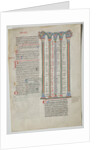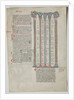
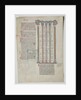
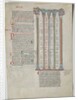
Single Leaf from a Decretum by Gratian: Quadruple Arcade with Concordance…, c. 1160-1165
Image information
Sizing information
| Overall size (inc frame) | x cm ( x in) |
| Depth | cm (in) |
| Artwork | x cm ( x in) |
| Border (mount) |
cm
top/bottom
(in)
cm left/right (in) |
| The paper size of our wall art shipped from the US is sized to the nearest inch. | |

Our prints
We use a 200gsm fine art paper and premium branded inks to create the perfect reproduction.
Our expertise and use of high-quality materials means that our print colours are independently verified to last between 100 and 200 years.
Read more about our fine art prints.
Manufactured in the UK, the US and the EU
All products are created to order in our print factories around the globe, and we are the trusted printing partner of many high profile and respected art galleries and museums.
We are proud to have produced over 1 million prints for hundreds of thousands of customers.
Delivery & returns
We print everything to order so delivery times may vary but all unframed prints are despatched within 1–3 days.
Delivery to the UK, Ireland, mainland EU & US is free when you spend £75. Otherwise, delivery to the UK costs £5 for an unframed print of any size.
We will happily replace your order if everything isn’t 100% perfect.
Product images of Single Leaf from a Decretum by Gratian: Quadruple Arcade with Concordance…, c. 1160-1165




Product details Single Leaf from a Decretum by Gratian: Quadruple Arcade with Concordance…, c. 1160-1165
Single Leaf from a Decretum by Gratian: Quadruple Arcade with Concordance…, c. 1160-1165
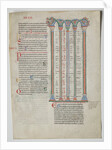
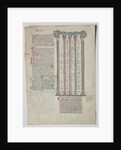
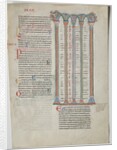
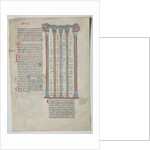
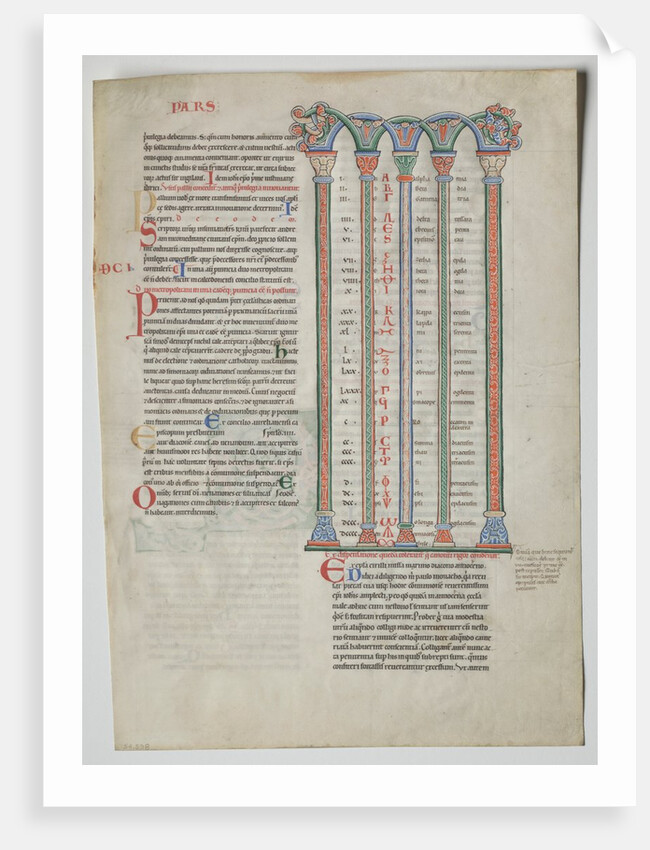
Single Leaf from a Decretum by Gratian: Quadruple Arcade with Concordance of Greek and Latin Alphabets , c. 1160-1165. This leaf was excised from a copy of the handbook of church law known as the Decretum written by Gratian, an Italian Camaldolese monk active in Bologna from about 1130 to 1140. The focus of the leaf is a large decorated letter Q with spiraling lotus petals introducing the first Causa , or case of law. The text begins, "A man having a son offered him to a very wealthy cloister." This case concerns the definition of simony (making profit from sacred things). The style of the illumination and the script date the leaf to between 1160 and 1165. In November 1164, Thomas Becket, Archbishop of Canterbury, took refuge at Pontigny as a result of his conflict with King Henry II of England. During his stay, Becket immersed himself in the study of church law, as evidenced by his later use of citations from the Decretum . This leaf could have been part of the original manuscript Becket consulted. The volume was later dismembered following the suppression of the monastery during the French Revolution in the late 1700s.
- Image ref: 2740849
- Heritage Art/Heritage Images
Find related images
zoom